
I Just Submitted a Paper. Let Me Tell You What It Actually Says.
I submitted an academic paper yesterday, and I’ll be honest — it made me a little nauseous.
Not because it’s my first. I’ve published a few of these, and every single one has done this to me. This one just had a different texture to the nausea. Hard to explain. You’d have to be a nerd about it, which, fine, I am.
Here’s the thing that made it weird: this is the first paper I’ve submitted since leaving the world of the big research university. No faculty cohort. No colleague down the hall who’s done this a hundred times and can tell you whether your formatting is off. (It was off. I caught it after I hit send, fixed it, resubmitted, and decided not to think about it ever again. Moving on.)
So it was just me. A framework I’ve spent years building in the actual messy field, not the lab. And a paper I wrote about it because somewhere in all those years in higher ed I absorbed the belief that if you figure something out, you’re kind of obligated to share it.
I wrote a little about that feeling on LinkedIn. But I left out the part you might actually want — what the paper says. So here we go.
The thing that happens to all of us at work
You know the feeling. A decision lands that affects your job, your team, your whole sense of where you stand — and you’re finding out about it right now, in this meeting, in this email, because somebody upstream decided you were finally ready to be told.
Not asked. Not included. Told.
The decision shows up fully formed. None of your fingerprints on it. And the quiet message underneath the whole thing is: your job here was always going to be to receive this, not to shape it.
I’ve been on the receiving end of that. I’ve also — and this is the uncomfortable part — been the person sending it. Most of us in communications have. Not because we’re careless. Because late is just... how it’s done. It’s the water we swim in.
And it costs us. The research on this is not subtle. When people don’t know what’s coming, uncertainty piles up, trust drains out, and rumor rushes in to fill the silence. By the time anyone shows up to “fix the communication,” they’re not designing anything. They’re doing cleanup.
So here’s the question I couldn’t let go of.
What if we borrowed a trick from the software people?
In software development, there’s this idea called shift-left.
The short version: bugs are cheap to fix early and brutally expensive to fix late. Catch a problem while you’re still sketching the thing? Easy. Catch it after it’s shipped to a million users? Now you’re in trouble, because everything got built on top of it. So good teams deliberately move their testing earlier — to the left on the timeline — instead of waiting until the end and praying.
And I kept thinking: why don’t we do this with communication?
Because change has a “ship date” too. There’s a moment when a decision stops being something we’re cooking up internally and becomes something people are living through. I call that moment the announcement threshold. It’s the line. On one side, the change is still soft and shapeable. On the other side, it’s real and it’s happening to people.
Almost everybody pours their communication energy onto the right side of that line — after the decision, after the announcement, after it’s already landed (often with a thud).
Shift-left communication says: move the work to the left. Get in there while the change is still forming, while questions are still open, while the thing can still be shaped by the people it’s about to affect. Do that, and by the time you cross the threshold, the announcement isn’t news. It’s confirmation of something people already feel part of.
Here’s what it looks like:
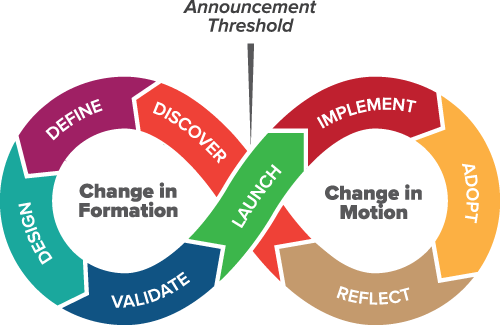
(That’s the whole framework. It loops. On purpose. More on that in a second.)
The eight phases, minus the jargon
Left side — Change in Formation (the part everybody skips):
Discover — Somebody spots a problem or an opportunity. It doesn’t have a shape yet. You don’t have to announce anything here. You just have to already be in honest conversation with your people about where the organization actually is. If you’re not, the rumor mill starts its first shift.
Define — You’re scoping it, weighing options. This is the most important phase and the one everybody blows past. You’re not announcing a decision — there isn’t one yet. You’re framing what’s even on the table.
Design — You shape a solution. And here’s where “audience” stops being a tactical afterthought (“who gets the email?”) and becomes structural (“who actually has a stake in this, and what would they tell us if we asked?”).
Validate — You test the message before you cross the line. My one-question gut check: Will the person reading this feel like a participant in this change — or like a recipient of it?
Right side — Change in Motion (the part everybody actually does):
Launch — The announcement goes out. If you did the left-side work, this is a calm “ah, yes, here it is.” If you didn’t, this is where the wheels start to wobble.
Implement — It rolls out. Your communication shifts from “here’s what’s happening” to “here’s how we get through it together.”
Adopt — People fold it into daily life. This is where you find out who’s bought in. Funny thing: people protect what they helped build, and quietly resist what got dropped on them — not out of spite, just out of not feeling any ownership. (Researchers call this the IKEA Effect. You feel weirdly attached to the wobbly bookshelf you assembled. Same energy.)
Reflect — You gather what you learned. And here’s my favorite part: Reflect isn’t the end. It’s the beginning of the next one. What you learn here is the raw material for the next Discover. That’s why the picture is a loop and not a line.
What the paper actually does with all this
It’s not just a nice diagram (although it is quite lovely, if I do say so myself). The paper takes the framework into a real, live organizational restructure and traces it through all eight phases — using a research method (analytic autoethnography, if you want the fancy academic term) that basically means I was in it, and I’m being rigorous and honest about being in it.
And the case even surfaced something the framework hadn’t accounted for yet — but that’s a story for when the paper’s out. :-)
Why I think this matters right now, specifically
We’re all a little raw at the moment. AI is reshaping jobs faster than anyone can hold a meeting about it. Trust in institutions is shaky. And a lot of people show up to work each day already flinching, braced for the next thing that’s going to happen to them.
Here’s what I’ve come to believe after years of this: resistance to change is almost never really about the change. It’s about people sensing they had no say in it.
Shift-left communication isn’t a magic fix for that — I’m not selling magic. But it’s a practice. A deliberate choice to treat people like participants instead of recipients, starting before the decision instead of after. And the research backs it: people will accept outcomes they wouldn’t have picked, as long as they believe the process that got there was fair. And the number-one thing that makes a process feel fair? Getting to weigh in before the decision is locked.
The announcement threshold is the moment every organization decides — on purpose or by accident — which of those two experiences it’s handing its people.
So. I don’t know what the journal will say yet. Peer review is its own special flavor of humbling, and I’ll let you know how it goes.
But I believe in this one. I’ve watched it work. I’ve watched what happens when it doesn’t. And I wrote it down because nobody should have to reinvent this from scratch in the middle of their own hard week.
It is never too late to start earlier.
Corrie A. Wilder, Ed.D., is Director of Communications, Outreach & Engagement at WSIPC and the creator of the Shift-Left Communication™ framework. She’s writing a book for anyone who’s ever had to sell an idea up the chain — or been in the room when an announcement landed wrong.
